
If you are looking to stock faucets or shower systems for the Finnish market, you have probably run into the acronym STF. You might be wondering: “Can’t I just use products with a standard CE mark?”
The short answer is: No, not really.
While the European Union tries to harmonize everything, sanitary tapware is a special case. There is no CE mark for how a faucet affects drinking water quality or how loud it is. To fill this gap, Finland uses its own system: the STF Type Approval.
As a wholesaler, here is your reality:
- Is it legally mandatory? Technically, no. It’s “voluntary.”
- Is it commercially mandatory? Absolutely. Most inspectors, housing companies, and professional plumbers check the STF mark before approving an installation.
Table of Content
- What Exactly is STF Certification?
- The Rules of the faucet wholesale for Finland
- The Testing Gauntlet I: Material Science and Hygiene
- The Testing Gauntlet II: Acoustic Performance
- The Testing Gauntlet III: Hydraulic and Mechanical Standards
- The Certification System & Process
- How to Spot a Real Certificate
- Future Trends and Regulatory Outlook
- Conclusion
- FAQs
What Exactly is STF Certification?
STF stands for Suomen Tyyppihyväksyntä (Finnish Type Approval). It’s a voluntary national approval used for construction products—like faucets and showers—that cannot carry a CE mark for certain properties.
STF confirms that a product meets the strict requirements of Finland’s Land Use and Building Act» and the Ministry of the Environment. In short, it’s the Nordic “seal of trust” that tells plumbers and inspectors: this faucet is safe for drinking water, won’t corrode and burst, and won’t cause noise issues.

The Rules of the faucet wholesale for Finland
You don’t need to be a lawyer, but you do need to know the basics so you don’t get stuck with unsellable inventory.
The “CE” Problem
In the construction world, CE marks are king—except for water fittings. Because there is no harmonized EU standard for things like “hygiene of drinking water faucets,” you cannot legally CE mark a faucet for those properties. This is why Finland created its own rules, specifically Decree 497/2019 and Decree 7/19.
These decrees basically say: “If you want to show that your product is fit for construction in Finland, get it Type Approved.”
The Key Takeaway for Sourcing
When you are talking to manufacturers (whether they are in Italy, China, or Germany), ask them one question immediately:
“Do you have a valid STF certificate for this specific model?”
Don’t settle for “It’s CE marked” or “It meets European Standards.” In Finland, that is often not enough.
The Testing Gauntlet I: Material Science and Hygiene
Material composition is the most scrutinized part of STF certification. Finland’s soft, acidic groundwater—shaped by its ancient granite bedrock—is highly corrosive to standard metals, making strict material controls essential.
The Dezincification Resistance (DZR) Imperative
Standard brass (copper–zinc alloy) dezincifies rapidly in Finnish water, where chlorides and low pH selectively leach zinc from the alloy. This leaves a porous, weak copper structure that can cause pinhole leaks or even valve-body failure—an unacceptable risk in Finnish buildings.
To prevent this, Decree 497/2019 effectively requires DZR brass. Compliance is tested under EN ISO 6509, and the dezincification depth must stay below 200 μm. Practically, this means manufacturers cannot use standard brass bodies made for Central or Southern Europe; they must use CR/DR-marked alloys with corrosion inhibitors or specific heat treatments to stabilize the brass
Heavy Metal Migration: Lead and Cadmium
STF places strong emphasis on preventing toxic metals from leaching into drinking water. Instead of only checking metal content in the brass, STF requires a 10-day migration test, where the faucet sits in standardized test water and samples are taken on days 1, 7, and 10 to simulate worst-case overnight stagnation.
Limits follow Decree 1352/2015 and Decision 268/1992, and they are intentionally strict:
- Lead (Pb): ~5 μg/L, often stricter than the general EU limit, pushing manufacturers toward low-lead or lead-free alloys.
- Cadmium (Cd): ~0.5 μg/L or lower, due to its high toxicity.
- Nickel (Ni) & Copper (Cu): Also monitored, with copper typically capped at 2.0 mg/L to avoid taste and health issues.
These requirements ensure that sanitary fittings used in Finland remain safe even under the country’s harsh water conditions.
Polymer and Elastomer Suitability
Components such as O-rings, cartridges, flexible hoses (PEX/EPDM), and aerators that come into contact with water must not degrade water quality.
- Organoleptic Testing: Finland requires sensory testing (taste and odor). A panel of trained testers assesses water that has been in contact with the polymer components to ensure no “plastic” taste or smell is imparted.
- Chemical Migration: Organic compounds (solvents, monomers) must not migrate in quantities exceeding the limits set for food contact materials. This often aligns with the principles of the Danish GDV or German KTW/UBA guidelines, but must be verified for the STF mark.
The Testing Gauntlet II: Acoustic Performance
A key hallmark of the Finnish approval system is its strict focus on acoustic emissions. In Finland’s dense urban housing, controlling noise transfer between apartments is a regulated quality-of-life requirement.
Acoustic Classification Groups
Decree 497/2019 mandates that sanitary fittings be classified based on the sound pressure level they generate at a reference flow pressure of 0.3 MPa (3 bar).
| Acoustic Group | Sound Pressure Level | Typical Application Environment |
|---|---|---|
| Group I | ≤ 20 dB(A) | Multi-story residential buildings, hospitals, hotels, luxury developments. |
| Group II | ≤ 30 dB(A) | Detached houses, renovations, utility spaces. |
| Unclassified | > 30 dB(A) | Generally unsuitable for residential use near sleeping/living quarters. |
The Physics of Faucet Noise
Faucet noise comes mainly from cavitation and turbulence as water moves through the cartridge and aerator. To meet Group I (<20 dB) requirements, manufacturers must use advanced flow engineering—silencer inserts to stabilize flow, low-noise aerators, and smooth internal body geometry to reduce turbulence.
Most faucets built for the US or Asian markets (where acoustics aren’t regulated) naturally fall into Group II or remain unclassified. Achieving Finnish Group I performance requires substantial R&D, creating a real barrier to entry for lower-tier competitors.
esting Methodology (EN ISO 3822)
Testing is conducted in specialized reverberation chambers accredited to EN ISO 3822 (“Laboratory tests on noise emission from appliances and equipment used in water supply installations”).
- The faucet is mounted on a standardized concrete wall with a specific mass.
- Water is circulated at 0.3 MPa (3 bar).
- Microphones measure the sound pressure level in the room.
- The results are “A-weighted” (dB(A)) to match the human ear’s sensitivity.
The Testing Gauntlet III: Hydraulic and Mechanical Standards
Beyond hygiene and noise, the STF mark confirms that the product works reliably as a mechanical device. The testing suite relies on a matrix of European Standards (EN) referenced by the National Decree.
Relevant EN Standards
The specific test standard depends on the product type:
- EN 817: Sanitary tapware – Mechanical mixing valves (single lever mixers). This is the most common standard for basin and kitchen faucets.
- EN 1111: Sanitary tapware – Thermostatic mixing valves. Critical for shower mixers to prevent scalding.
- EN 1112: Shower outlets (hand showers). Tests for spray coverage and flow consistency.
- EN 1113: Shower hoses. Tests for tensile strength and flexibility.
- EN 15091: Electronic sanitary tapware. Covers touchless faucets, focusing on battery life, sensor response, and solenoid valve durability.
Key Performance Tests
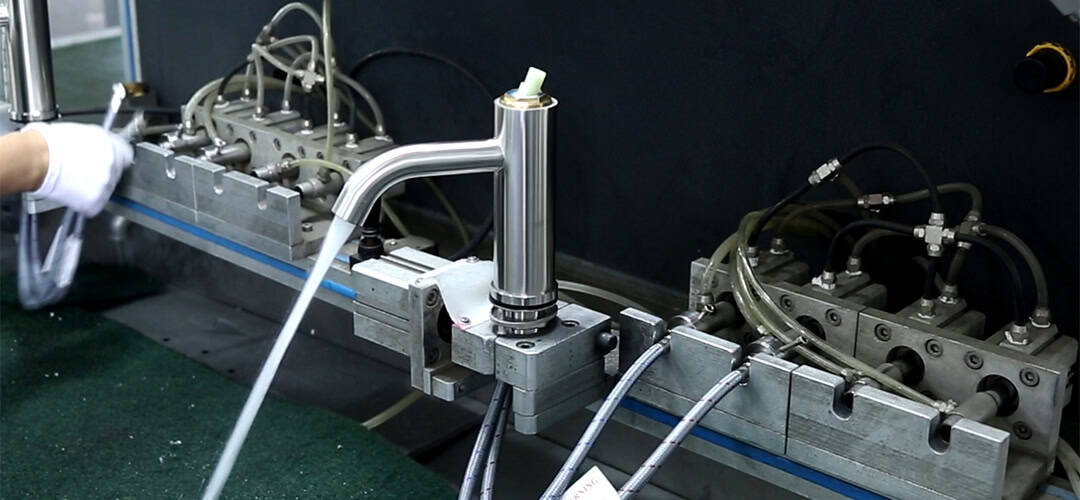
- Leaktightness: The faucet body is pressurized (≈16 bar) to verify the casting has no porosity, and the cartridge must fully seal under mains pressure.
- Pressure Resistance: Components must withstand high surge pressures—up to 25 bar—to ensure they won’t burst during water hammer events.
- Mechanical Endurance: Single-lever mixers undergo the 70,000-cycle EN 817 test, simulating 10–15 years of use. Any failure—such as a cracked cartridge stem—means instant disqualification.
- Cross-Flow Prevention: Thermostatic mixers require check valves to stop hot and cold lines from backfeeding, protecting pressure balance and hygiene.
The Certification System & Process
How does a factory actually get this paper? It’s not just about mailing a sample. It is a rigorous process involving authorized bodies like Eurofins Expert Services or Kiwa.
The 5-Step Workflow
- Application: The manufacturer sends technical drawings, bills of materials (BOM), and brass specifications to the Certification Body.
- Sampling: You can’t just send a “golden sample.” Often, an inspector must select samples randomly from the production line to ensure they represent what you will actually buy.
- Type Testing (The Long Wait): The samples go to an accredited lab (e.g., VTT, Eurofins, or a partner lab). They undergo the hygiene, acoustic, and corrosion tests. This takes 2-4 months.
- Factory Production Control (FPC): This is critical. The factory must agree to a Quality Control contract. An external inspector visits the factory to verify they check dimensions and markings daily (sometimes every 4 hours!).
- Decision & Surveillance: If everything passes, the STF Certificate is issued.
- Validity: It is valid for 5 years.
- Maintenance: The inspector returns annually to audit the factory. If quality drops, the certificate is revoked.
How to Spot a Real Certificate
Don’t get scammed. Here is what to check when a supplier sends you a PDF:
- Check the Issuer: Is it from a recognized body like Eurofins Expert Services or Kiwa?
- Check the Expiry: Look for the “Valid Until” date. It should be within the 5-year window.
- Check the Annex: The certificate will have an appendix listing specific Model Numbers. Ensure the exact model you are importing is on that list.
- Look for the Mark: The product itself should carry the STF logo or type approval mark on the body or packaging.

Future Trends and Regulatory Outlook
The regulatory landscape is not static. Several emerging trends will shape the future of STF certification.
The Recast EU Drinking Water Directive (DWD)
The implementation of Directive (EU) 2020/2184 is harmonizing the “Positive List” of materials accepted for drinking water contact across Europe.
Impact: EU-wide harmonization may eventually unify chemical migration testing, reducing the need for separate Finnish tests. However, Finland is likely to retain its strict acoustic and dezincification requirements, as these relate to climate and performance, not just hygiene. The STF mark may evolve, but it will remain essential.
Digitalization and “Smart” Water
As faucets become electronic gadgets (touchless, Bluetooth-connected), the certification landscape complicates.
- Dual Compliance: An electronic faucet needs STF (for water) and CE (for electronics/EMC/LVD).
- New Standards: Testing against EN 15091 involves assessing battery life and solenoid reliability. The STF process is adapting to include these evaluations as standard for public-use fixtures.
Sustainability and Eco-Design
There is growing pressure to integrate environmental performance into the approval.
- Water Efficiency: While Decree 497/2019 sets “normal flows,” future revisions may mandate maximum flow rates to align with Green Building standards (LEED, BREEAM).
- Carbon Footprint: Some Nordic certifications (like SINTEF) are beginning to look at Environmental Product Declarations (EPDs). The STF system may soon require EPDs as part of the documentation package.
Conclusion
The Finnish STF certification reflects Finland’s uncompromising standards for building quality and public health. It is a rigorous, multi-layered system designed to eliminate products that can’t withstand the chemical aggressiveness of Finnish water or the strict acoustic demands of Finnish housing.
For builders, STF is the gold standard for quality and liability protection. For manufacturers, it is a challenging but valuable gateway to a stable, high-end market—one that requires real expertise in metallurgy, acoustics, and compliance. Those who master it gain a durable competitive edge that lower-tier competitors struggle to match.
Even as Europe moves toward harmonized material rules and digital water management, STF remains Finland’s national safeguard—ensuring that water in Finnish homes is safe, delivered through durable fixtures, and heard as little as possible.
