
If you’re a builder, wholesaler, or importer planning to supply faucets and mixers to South Africa, you already know this market is different. You can’t simply import generic “high-quality” taps and expect them to sell.
Water is a strategic resource in South Africa, and regulations are strict. Choosing the wrong products risks failed inspections, rejected insurance claims, and unsellable stock.
This guide cuts through the acronyms—SABS, SANS, JASWIC, SATAS—and shows you exactly what to look for when sourcing compliant plumbing fittings for the South African market.
Table of Content
The “Big Three” You Need to Know
First, let’s simplify the landscape. You’ll hear these three acronyms constantly. Here is who they are and why you should care.
SANS (The Rule Book)
South African National Standards. This is the technical “Bible.”
- SANS 226: This covers your standard screw-down taps (the ones with rubber washers, like pillar taps and bib taps).
- SANS 1480: This covers single-lever mixers (the modern ones with ceramic cartridges). Your takeaway: If a supplier says their tap meets “European Standards” (EN 817) but doesn’t mention SANS, be careful. South Africa has specific local deviations—mostly about the metal used—that European taps often fail.
SABS & SATAS (The Referees)
These are the certification bodies. They test the products to make sure they follow the SANS rules.
- SABS (South African Bureau of Standards): The old guard. Very famous, very trusted.
- SATAS (South African Technical Auditing Services): The challenger. Also fully accredited and legally equal to SABS. Your takeaway: A certificate from either of these is gold. Don’t let anyone tell you SATAS isn’t valid; in the eyes of the law and the insurers, it is 100% equal to SABS.

JASWIC (The Gatekeeper)
Joint Acceptance Scheme for Water Services Installation Components. This is the big one. JASWIC is a list used by municipalities (like Cape Town and Joburg) to check if a product is allowed to be installed.
Your takeaway: If your product isn’t on the JASWIC list, a building inspector can refuse to sign off on the house. For a builder, this is a nightmare. Always aim for products that are JASWIC listed.

Technical Standards Framework (SANS)
To sell faucets in South Africa, products must comply with South African National Standards (SANS), which are based on ISO/EN norms but adapted to local conditions such as high UV exposure and water quality.
SANS 226: Metallic Water Taps (Screw-Down Type)
Full title: Metallic water taps (including stop taps) for the supply of water at temperatures not exceeding 75 °C (SANS 226)
Scope: Traditional screw-down taps using rubber washers, including pillar taps, bib taps, and stop taps.
Key technical requirements:
- Dimensional standards: Must comply with specified thread and connection sizes (typically 15 mm or 20 mm BSP) to ensure compatibility with South Africa’s standard piping systems.
- Pressure testing: Products must withstand specified hydraulic pressure tests without leakage or deformation.
- Material requirements: Must be made from dezincification-resistant brass (DZR brass) and carry permanent identification markings.
SANS 1480: Single-Control Mixer Taps
Full title: Single control mixer taps (SANS 1480)
Scope: Modern single-handle hot and cold mixer taps, widely used for basins, kitchen sinks, and showers.
Key technical requirements:
- Cartridge durability: Ceramic cartridges must pass tens of thousands of open/close cycle tests to simulate long-term use.
- Flow performance: Unlike older standards, SANS 1480 specifies flow-rate characteristics under different pressure conditions to ensure consistent user experience.
- Anti-scald protection: Certain provisions address hot water limiting devices to reduce the risk of accidental scalding.
SANS 1808: Plastic Taps and Valves
Full title: Water supply and distribution system components – Polyolefin
While brass remains the mainstream material, polyolefin (plastic) taps are widely used in low-cost housing and outdoor applications.
- SANS 1808-35: General standard for plastic taps and valves.
- SANS 1808-66: Time-delayed self-closing taps (demand taps), commonly used in public facilities for water conservation.
The “DZR” Trap: Why Standard Brass is Illegal
Here is the most common way importers get burned. South Africa has “aggressive” water in many areas (high chloride content). This water attacks standard brass, leaching out the zinc until the tap turns into a pink, porous sponge and snaps off. This is called Dezincification.
To prevent this, South African law mandates DZR Brass (Dezincification Resistant Brass).
- The Risk: You might find a beautiful tap in China or Italy that is perfectly legal there. But if it’s made of standard brass, it is illegal to install in South Africa.
- The Mark: How do you know? Pick up the tap. Look closely at the body. You should see a permanent marking stamped or cast into the metal: “DZR”, “DR”, or “CR”.
- No Mark = No Sale: If that mark isn’t there, walk away. It doesn’t matter how cheap it is; if it floods a luxury apartment, you are liable.
Certification Process and Market Access Guide
For manufacturers seeking to enter the South African market, achieving compliance requires following a strict and clearly defined process.
Step One: Choose a Certification Body
Manufacturers must select a certification body accredited by SANAS. The main options are SABS and SATAS. Both are legally equivalent, and companies typically choose based on service efficiency and cost.
Step Two: Type Testing
Product samples must be submitted to an accredited laboratory (ISO/IEC 17025) for full type testing.
Test scope includes:
- Dimensional inspection
- Hydraulic pressure testing (typically 1.5 to 2 times the rated working pressure)
- Cartridge life-cycle testing
- Plating/coating quality tests
- The critical ISO 6509 dezincification resistance test
Test reports:
Laboratory test reports form the basis of certification applications, but test results alone do not demonstrate long-term compliance, as they only represent the tested samples.
Step Three: Factory Audit & Certification
This step distinguishes merely “passing tests” from being fully certified. The certification body will send auditors to the manufacturing facility, whether located in South Africa or overseas.
Audit scope includes:
- Quality management systems (typically ISO 9001)
- Production process control
- Raw material batch traceability (ensuring all brass used is DZR brass)
Certification outcome:
Once the audit is successfully completed, a SANS Product Certificate is issued, and the manufacturer is authorized to apply the relevant certification mark on the product (SABS Mark or SATAS Mark).
Step Four: JASWIC Listing
After obtaining SANS certification, manufacturers must apply to JASWIC.
Review:
The JASWIC committee reviews the validity and scope of the certification.
Listing:
Approved products are entered into the JASWIC database. This listing serves as the practical “passport” for access to municipal projects, large-scale construction works, and major retail chains.
| Feature | SABS (South African Bureau of Standards) | SATAS (South African Technical Auditing Services) | JASWIC (Joint Acceptance Scheme) |
|---|---|---|---|
| Organization type | State-Owned Company (SOC) | Private company | Industry consortium |
| Primary role | Standards development & product certification | Product certification | Management of municipal acceptance listings |
| Accreditation | SANAS accredited | SANAS accredited | Operates based on SANAS certificates |
| Output | SANS standards, SABS Mark | SATAS Mark | Accepted Product List |
| Market recognition | Long-established brand with very high consumer recognition | Strong industry recognition, flexible service | Enforcement reference for building inspectors |
How to Verify a Supplier (A Step-by-Step Guide)
You’re talking to a new supplier who claims they are “fully certified.” Do not just take their word for it. Here is your due diligence checklist.
Step 1: Ask for the Certificate
Ask them to email you their Product Certification Certificate.
- Look for: The SABS or SATAS logo.
- Check the Date: Is it expired? These are usually valid for 3 years.
- Check the Scope: Does the certificate actually list the specific model numbers you are buying? A common trick is to show a certificate for a “Basin Mixer” and then sell you a “Sink Mixer” that wasn’t tested .
Step 2: The “SANAS” Check
Ensure the certificate comes from a body accredited by SANAS (South African National Accreditation System). If the test report is from a random in-house lab in another country, it’s worthless in South Africa unless validated by a local accredited body.
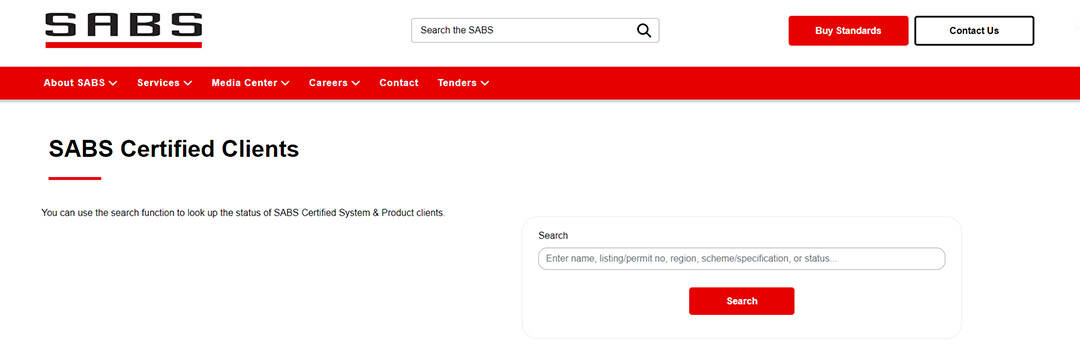
Step 3: The SABS & JASWIC Online Search
This is your secret weapon. You don’t need to guess; you can look it up.
- Go to the(http://www.jaswic.co.za») or (https://www.sabs.co.za/sabs-certified-clients»).
- Look for the “Accepted Products List.”
- Search for the supplier’s brand name.
- Status: If they are on this list, you are generally safe. It means the municipalities have already vetted them.
Step 4: Physical Inspection
When you get a sample:
- Find the DZR Mark: Look for “DR” or “CR” on the body.
- Find the Manufacturer’s Code: SANS 1480 requires the manufacturer’s name or trademark to be marked on the product. A completely blank tap is a red flag.
Future Outlook: Water Efficiency Labelling Scheme (WELS)
South Africa’s regulatory focus is shifting from purely “mechanical safety” toward water efficiency. This change will raise the compliance threshold for plumbing products in the coming years.
Background and Current Status of WELS
Although not yet fully mandatory, the South African Department of Water and Sanitation (DWS) has clearly stated its intention to implement a Water Efficiency Labelling Scheme (WELS), with a target to establish the framework around 2025.
This scheme will be similar to Australia’s WELS or the United States’ WaterSense program, requiring products to display water-efficiency ratings.
SANS 3088: Water Efficiency in Buildings
As the technical foundation of WELS, SANS 3088 (Water efficiency in buildings) has already been published. This standard sets maximum flow-rate limits for different sanitary fixtures and is expected to be incorporated into SANS 10400-XB, making it a mandatory building regulation.
| Fixture Type | Application | Maximum Flow Rate | Notes |
|---|---|---|---|
| Basin tap | Public areas | 6 L/min (at 300 kPa) | |
| Basin tap | Other (residential, etc.) | 5 L/min (at 600 kPa) | |
| Kitchen sink tap | Residential kitchens | 10 L/min | Aerator required |
| Kitchen sink tap | Commercial cooking facilities | 15 L/min | |
| Shower head / shower mixer | All applications | 10 L/min | Proposed; may be tiered |
Impact on Manufacturers
Many currently compliant faucets (meeting only SANS 226 / SANS 1480) may have flow rates that are too high (e.g., 20 L/min). Once WELS becomes mandatory, such products may be prohibited from sale or installation, even if their mechanical performance is compliant.
Manufacturers will need to redesign cartridges and aerators to meet lower flow-rate requirements and ensure future compliance.
Summary: Your Safe Sourcing Strategy
To sleep soundly at night, your purchase order should require three things:
- Compliance with SANS 226 (Taps) or SANS 1480 (Mixers).
- A valid SABS or SATAS certificate.
- Components made of DZR Brass, marked “DR” or “CR”.
If you stick to this list, you aren’t just buying taps; you’re buying peace of mind. You’re protecting your customers from leaks and yourself from liability.
